
There is a version of this conversation where someone tries to convince you that a visitor management system is worth the investment by listing features and throwing statistics at you. This is not that.
Instead, let’s talk about what actually happens inside a busy office without one, because that is where the real cost lives. Not in dramatic security failures, but in the small, daily friction that nobody has put a number on yet: the receptionist switching between tabs to log a visitor in a shared spreadsheet, the host who never got notified and left a client waiting in the lobby for twelve minutes, the compliance audit where someone had to manually pull three months of visitor records from a Google Sheet that two people had been editing inconsistently.
These are not edge cases. They are Tuesday.
A visitor management system does not just digitise your sign-in process. It removes a specific category of operational drag that most businesses have quietly accepted as normal. Here is where the value actually shows up.
1. Reduced Administrative Workload
Most offices today track visitors digitally, a spreadsheet, a shared document, a field in the CRM. The problem is not that it’s paper. The problem is that it still requires someone to stop what they are doing, open the right file, enter the details, save it, then switch back to whatever they were doing before. Multiply that by every visitor, every day, across a team that also handles calls, deliveries, meeting room bookings, and everything else reception manages.
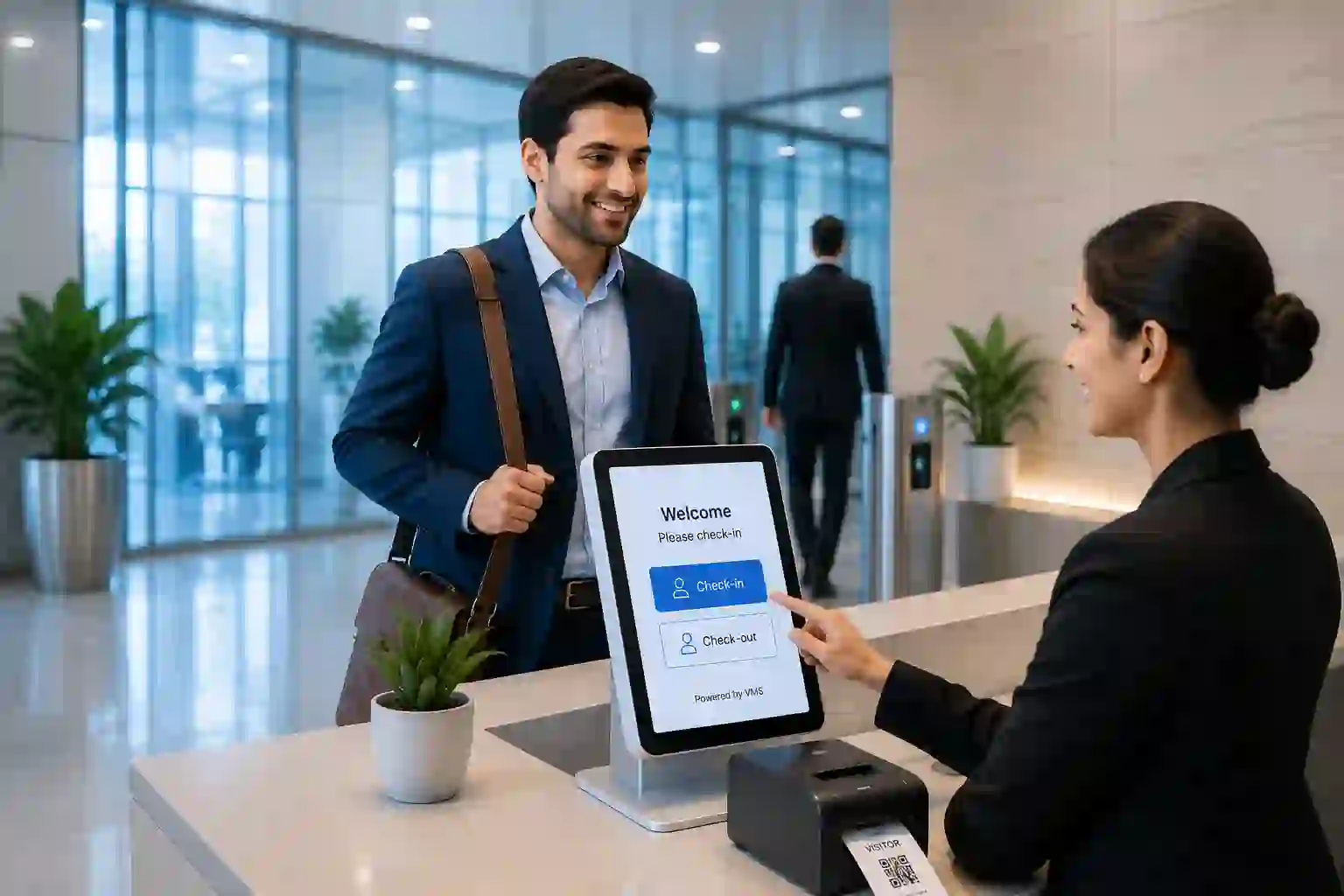
A visitor management system removes that task from the human queue entirely. The visitor checks themselves in at the kiosk. The record is created automatically. The host is notified without anyone picking up the phone. Your front desk team does not disappear, they just stop being the bottleneck.
2. A Better Experience for Every Visitor
Here is a scenario most offices know well. A visitor arrives. The receptionist calls up to the host’s desk. No answer. They try a mobile number. Voicemail. Meanwhile, the visitor is standing in the lobby, checking their watch, forming an opinion about the company they are about to walk into.
This is fixable, and it is one of the clearest immediate wins a visitor management system delivers. The moment a visitor checks in, their host gets a notification – SMS, email, or both – with the visitor’s name, photo, and arrival time. No chasing. No waiting on hold. The host knows within seconds and can respond accordingly.
For client-facing businesses in the UAE where senior executives, investors, and government officials regularly walk through the front door, that twelve-minute lobby wait is not a minor inconvenience. It is the first data point in a relationship.
3. A Stronger First Impression
When a visitor walks in and is greeted by a clean, intuitive kiosk, scans their Emirates ID, receives a printed badge, and gets a confirmation that their host has been notified, they experience that as a reflection of how the organisation operates.
When they walk in and someone has to find the right tab in a browser, ask them to spell their name twice, and then type it in while also answering a phone call, they experience that as a reflection too.
Ninety percent of visitors consider the check-in experience a direct signal of how professional the business is. In competitive markets, that perception carries real commercial weight. The lobby is not a waiting room. It is where opinions form.
4. Complete Visibility of Building Occupancy
Ask most office managers how many people are currently in their building and you will get an estimate, not an answer. Visitor logs get updated inconsistently. People forget to sign out. Contractors come and go across multiple entry points. By mid-afternoon, the official record and the reality of who is actually on the premises can look very different.
This matters most in two situations: emergencies and audits. During an evacuation, you need an accurate headcount instantly, not a spreadsheet you have to cross-reference. During a compliance review, you need a complete visitor record, not a file that three different people have had edit access to over the past quarter.
IX VISPRO maintains a live dashboard showing exactly who is checked in at any given moment, across every location. In an emergency, that list is available on any authorised device in seconds. For an audit, visitor reports export instantly in Excel or PDF, no assembly required.
5. Stronger Workplace Security
Most workplace security systems deal with problems after they have already occurred. A visitor management system moves that line earlier. Before someone enters the building, their identity has been verified, their details have been recorded, and, where configured, they have been screened against a watchlist.
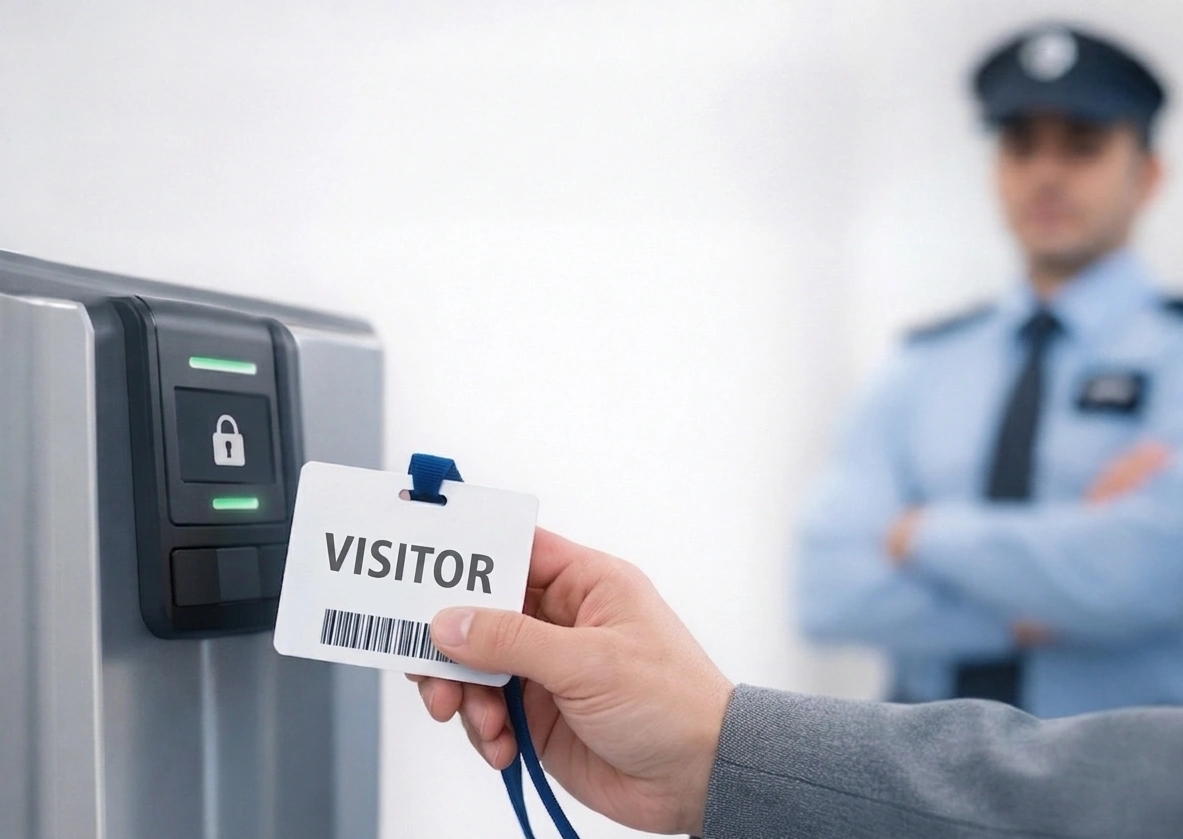
For UAE businesses, Emirates ID and passport scanning adds a layer of verified identity that a spreadsheet entry simply cannot provide. The system captures who the person actually is, not just the name they typed in a form. Badge printing ensures that anyone on the premises is visibly identifiable, staff can see at a glance who belongs in a given area and who does not.
None of this requires additional headcount. The system does the checking. Your team focuses on the work.
6. Consistent Standards Across Every Location
Running visitor management across multiple locations without a unified system is genuinely difficult. Each site develops its own process. Data lives in different places. If something happens at one location and you need to pull records, you are starting a phone chain rather than running a query.
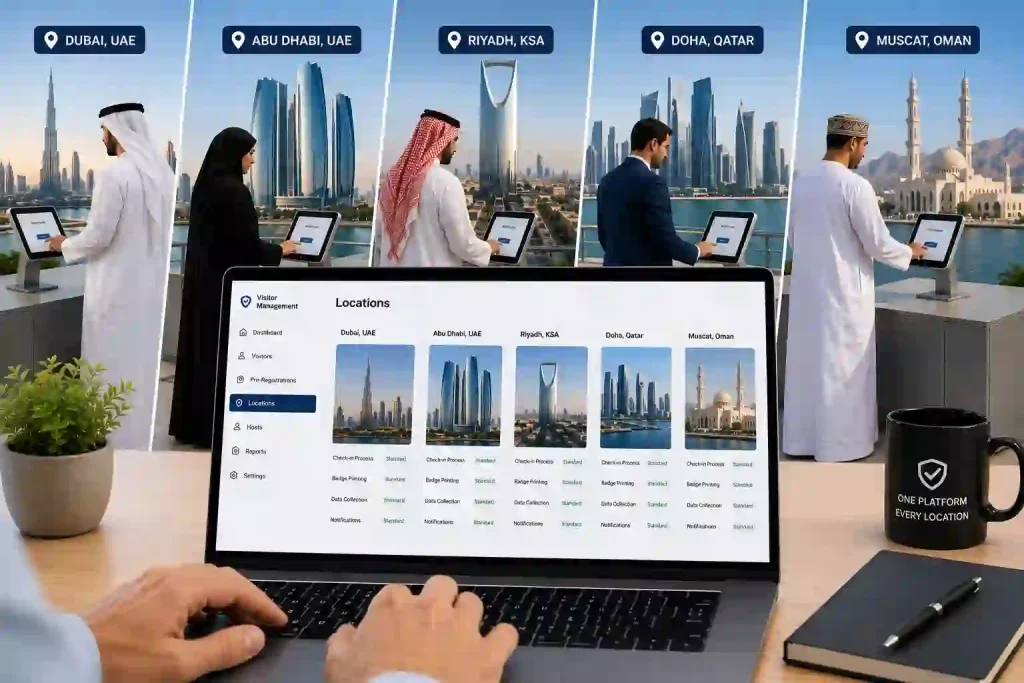
A centralised visitor management platform gives you visibility across every site from a single dashboard. Standards are consistent regardless of location. Reports cover the whole operation, not just whichever site remembered to update their spreadsheet. For businesses operating across the UAE, or across the wider region, this is less a convenience and more a necessity. IX VISPRO serves organisations across the Middle East, Africa, and beyond, bringing the same consistent standards to every market we operate in.
7. Audit-Ready Compliance Records
Compliance reviews have a way of arriving at inconvenient times. Whether it is a data protection audit, a health and safety inspection, or a regulatory review specific to your industry or free zone, the question is always the same: can you demonstrate that you have maintained accurate, secure visitor records?
If your answer involves opening a shared file and hoping it is complete, that is a risk. GDPR and UAE data protection regulations both carry real penalties for inadequate record-keeping, and a visitor log that anyone with the link can edit is not adequate by any reasonable standard.
A digital visitor management system keeps records complete, timestamped, and access-controlled from the moment a visitor checks in. When a compliance requirement lands, the documentation is already there. No scramble, no gaps, no exposure.
What the Investment Looks Like
The honest answer is that the ROI depends on your operation. A single-location business with light visitor traffic will see a different return than a multi-site organisation handling hundreds of visitors weekly. But across almost every scenario, the combination of time saved, risk reduced, and experience improved adds up to more than the cost of the platform.
Most organisations that make the switch reach positive ROI within the first year. Many do it faster, simply because they had no idea how much the old process was quietly costing them until they stopped doing it.
If you want to see what this looks like for your specific setup, IX VISPRO offers a purpose-built visitor management and kiosk solution for the UAE market, Emirates ID scanning, pre-registration, instant reporting, and automated host notifications included. We also work with businesses across the MEA region and Africa, adapting our solution to meet local requirements wherever you operate. Book a demo and find out what your front desk could actually look like.