

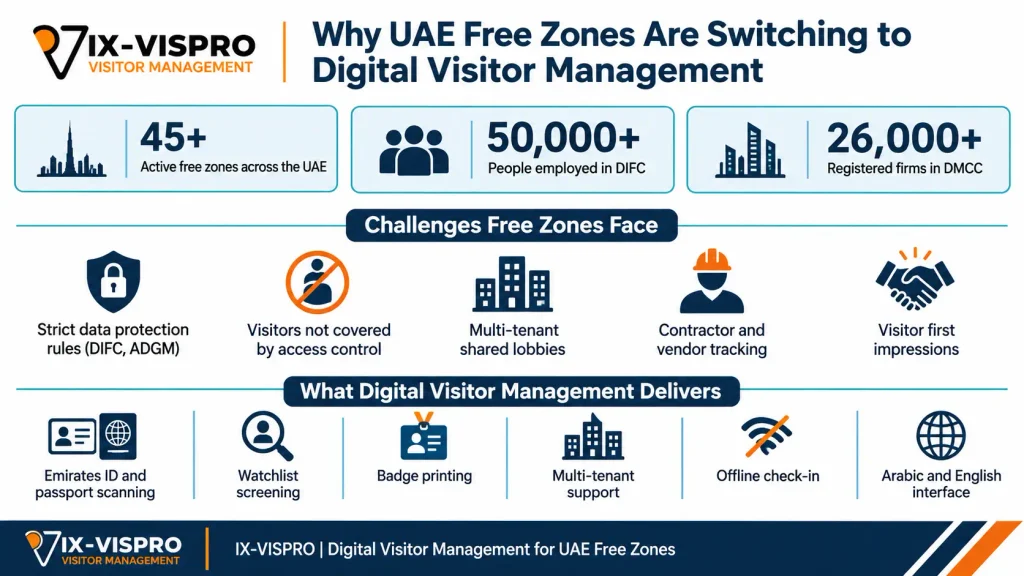
The UAE is home to more than 45 active free zones spread across all seven emirates. DIFC alone employs over 50,000 people as of 2025. DMCC has surpassed 26,000 registered firms. JAFZA, Dubai Internet City, Dubai Media City, ADGM, each of these is effectively a city within a city, with its own regulatory framework, its own access requirements, and its own daily flow of visitors, contractors, clients, and delegations passing through the front door.
That scale creates a visitor management problem that is fundamentally different from a standard corporate office. And it is driving a noticeable shift toward digital visitor management across the free zone sector.
The Free Zone Environment Is Not a Standard Office
A company in DIFC or ADGM is not just operating in a building. It is operating inside a regulated financial jurisdiction with its own data protection law, its own compliance expectations, and its own commissioner who conducts supervisory visits. The DIFC Data Protection Law and the ADGM Data Protection Regulations 2021 both set out specific obligations for how personal data, including visitor data, is collected, stored, and managed.
That regulatory layer changes what visitor management needs to deliver. It is not enough to know who visited. The organisation needs to demonstrate how identity was verified, how long data is retained, who has access to it, and how it is protected. A shared spreadsheet or paper logbook cannot answer those questions in any audit-ready way.
A digital visitor management system built for this environment supports that documentation effort. Every check-in is timestamped with verified identity, records are encrypted and access-controlled, and reports are available on demand without anyone having to compile them manually. Whether that meets an organisation’s specific compliance obligations depends on how the system is configured and used, and legal advice should be sought where needed.
Security Expectations Are Higher in Regulated Free Zones
Walk into any building in DIFC or ADGM and the security posture is visibly different from a standard commercial tower. Turnstiles, access control at every floor, security personnel at reception. These environments are designed to be controlled.
Access control systems are primarily designed around enrolled employees with assigned credentials. While some access control platforms can be extended to support visitor permissions, managing the full visitor lifecycle, identity capture, host notification, badge issuance, and visit records, typically requires a dedicated visitor management layer sitting alongside it.
A lawyer arriving for a client meeting, a regulator conducting an inspection, a job candidate coming in for an interview, a contractor servicing the IT infrastructure, none of these people are enrolled in the access control system. Without a visitor management layer, they move through the facility on trust and a manual sign-in that may or may not be complete.
IX-VISPRO is designed to work alongside existing access control infrastructure. Emirates ID and passport scanning verifies who a visitor actually is at the point of arrival. Watchlist screening flags any matches against configured watchlists before entry is granted. Badge printing makes every visitor visibly identifiable throughout their stay. Where zone-based access control is configured, IX-VISPRO works with the access control system to manage where visitors are permitted to go.
For a free zone organisation subject to regulatory oversight, that combination supports a more complete and documented approach to physical security.
Multi-Tenant Buildings Need Consistent Standards Across the Floor
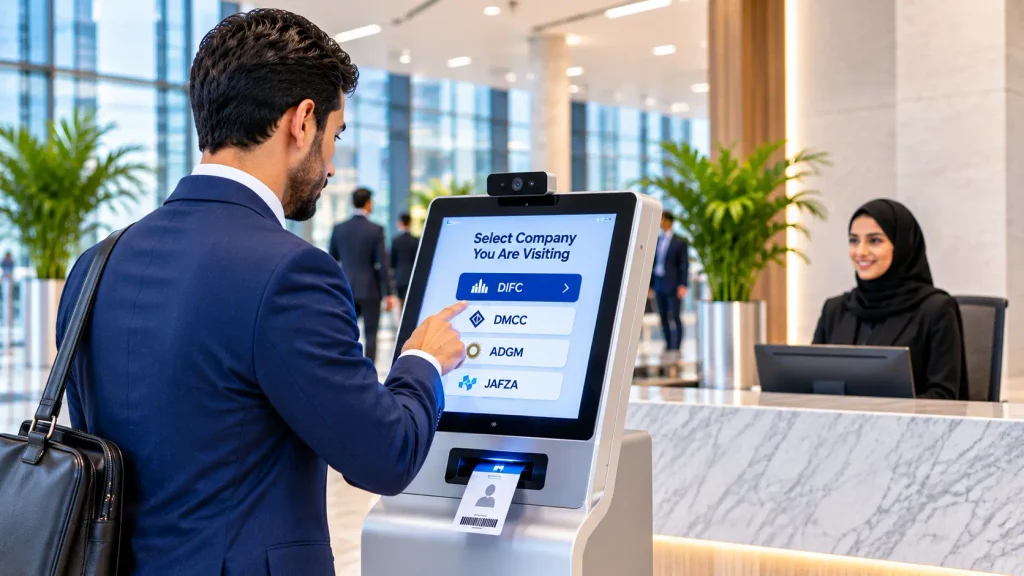
Free zone buildings in DIFC, Dubai Media City, and similar locations are typically multi-tenant. The lobby is shared. Visitors arrive for different companies on different floors, often simultaneously, and the reception experience needs to handle all of them without confusion.
This is where manual processes break down most visibly. A receptionist managing walk-ins for five different tenants, trying to call the right contact for each, logging details into separate systems or a shared spreadsheet, handling a delivery at the same time. The result is inconsistency, delays, and a visitor experience that varies depending on the time of day and who is at the desk.
A self-service kiosk handles all of it consistently. The visitor selects the company they are visiting. The system identifies their host, notifies them instantly, and prints a badge specific to that company and that floor. Each tenant gets a clean, complete record of their own visitors without depending on shared reception staff to maintain it.
Contractor and Vendor Management Is a Daily Reality
Free zone facilities in JAFZA, Dubai South, and similar industrial and logistics zones handle a different visitor profile: contractors, vendors, maintenance crews, and delivery personnel moving in and out of restricted areas throughout the working day.
Managing this manually is both operationally difficult and a genuine security risk. Without a systematic record of who is on site and where they are cleared to go, there is no reliable way to enforce access restrictions or account for everyone on the premises if something goes wrong.
IX-VISPRO manages contractor access with the same system that handles client visits. Zone-specific permissions are set at check-in and enforced in conjunction with the facility’s access control infrastructure. Where the system is configured to do so, movement outside authorised zones can trigger an alert. At the end of the day, a complete record shows who was on site, when, and for how long. Explore the IX-VISPRO integration capabilities to see how it connects with existing access control and gate management infrastructure.
First Impressions Matter in a Business Destination
DIFC, ADGM, and Dubai’s major free zones attract some of the most internationally experienced business visitors in the region. The executives, investors, and senior clients walking into these buildings have worked in world-class facilities across global financial centres. They notice when the check-in experience is below the standard of the building around it.
A visitor who arrives at a leading financial institution in DIFC and waits while a receptionist tabs through a spreadsheet is forming an impression, not just about the building, but about the organisation they are about to meet. That impression is formed before a single word is exchanged.
A kiosk-based check-in that verifies identity, prints a badge, and notifies the host in under a minute says something different. It signals that this organisation operates at the same level of professionalism it projects everywhere else.
What to Look for in a Free Zone Deployment
Not every visitor management solution is designed for the specific requirements of UAE free zone environments. The features that matter most here are:
- Emirates ID and passport scanning for verified identity at entry, not self-reported information
- Data protection alignment with DIFC, ADGM, and UAE PDPL requirements, including encrypted storage, access controls, and configurable retention periods
- Multi-tenant support so each company in a shared building manages its own visitor records independently
- Offline functionality to maintain check-in capability when internet connectivity drops (confirm with the vendor how data syncs once connectivity is restored)
- Zone-based access control for facilities with restricted areas or multi-floor access management
- Arabic and English interface as a baseline for the UAE market
The Shift Is Already Happening
Free zone authorities across the UAE are raising the bar on what compliant, secure, professional facility management looks like. The organisations inside those free zones are following the same direction, in part because of regulatory expectation, in part because of competitive pressure, and in part because a modern visitor experience is simply part of what clients and partners expect when they walk through the door.
IX-VISPRO is built for exactly this environment. If you are managing a facility inside a UAE free zone and evaluating what digital visitor management looks like in practice, get in touch with the team to discuss your specific requirements.