Dubai has never been a city that does things halfway. When the government committed to making Dubai the smartest city in the world, it did not mean smarter traffic lights and better Wi-Fi. It meant rethinking every layer of how the city operates , from how residents pay utility bills to how government services are accessed, and increasingly, how businesses welcome the people who walk through their doors.
The Dubai Economic Agenda D33 targets an annual contribution of AED 100 billion from digital transformation projects alone. That ambition does not stay within government buildings. It sets a tone, an expectation, that every institution operating in Dubai should reflect the same standard of efficiency, technology, and professionalism that the city projects to the world.
For corporate businesses, that expectation arrives first at the reception desk.
The City Is Moving Forward. Some Lobbies Are Not
Walk into a modern Dubai office tower and you might find a stunning atrium, floor-to-ceiling glass, and a reception area designed by an award-winning firm. Then the visitor signs into a spreadsheet on a shared laptop, waits while the receptionist dials an internal extension, and stands around for eight minutes while someone figures out which floor they need to go to.
The disconnect is real, and it is more common than most organisations want to admit. The building reflects Dubai’s ambition. The process inside it does not.
Dubai no longer treats digital systems as support tools, they now function as the foundation of how the city operates. Businesses that have not applied that same logic to their own operations are quietly falling behind the standard their clients, partners, and employees already expect.
What Smart Reception Actually Looks Like
The shift is not complicated. It does not require a lobby renovation or a new IT infrastructure project. It requires replacing a manual, staff-dependent check-in process with one that is automated, verified, and seamless from the moment a visitor arrives.
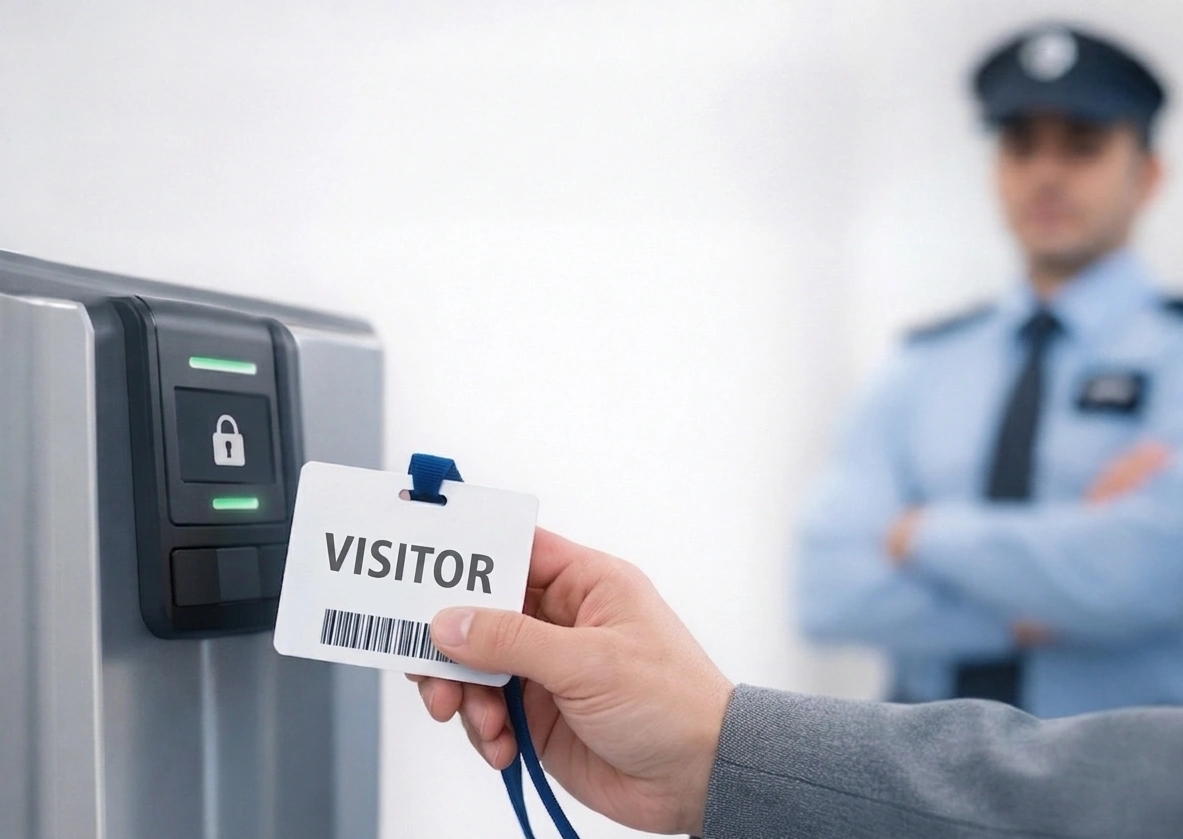
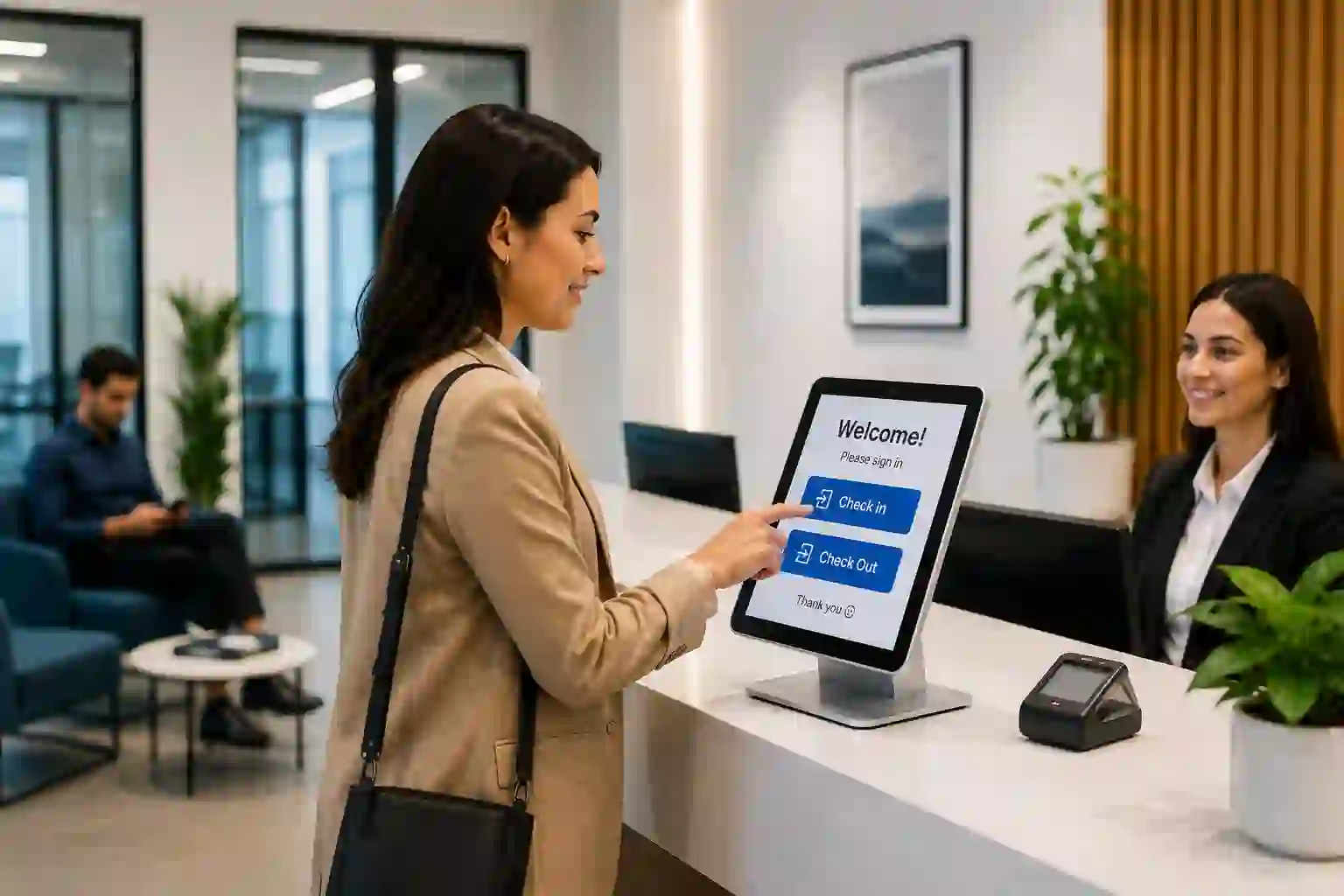
In practice, a smart reception experience powered by IX VISPRO works like this: a visitor walks in and approaches a self-service kiosk. They scan their Emirates ID or present a pre-registered QR code. The system verifies their identity, prints a badge with their name and photo, and sends an instant notification to their host, all within 60 seconds. If the building has elevator integration, the kiosk calls the lift to the lobby and directs the visitor to the correct floor without any staff involvement.
No phone calls. No waiting. No one chasing down a host who did not hear their desk phone. The visitor has been welcomed, verified, badged, and directed, and the receptionist has not had to stop what they were doing.
That is not a futuristic concept. It is what leading corporate facilities across Dubai are deploying right now.
The VMS Is Not Just Operational
There is a practical efficiency argument for smart reception, faster check-in, less admin, fewer bottlenecks. But the more significant argument is commercial.
Dubai is one of the most internationally connected business cities in the world. The clients, investors, and partners walking into corporate offices here have likely just come from Singapore, London, or New York. They have experienced world-class facilities in all of those cities. They are, consciously or not, benchmarking your organisation against every other place they have done business.
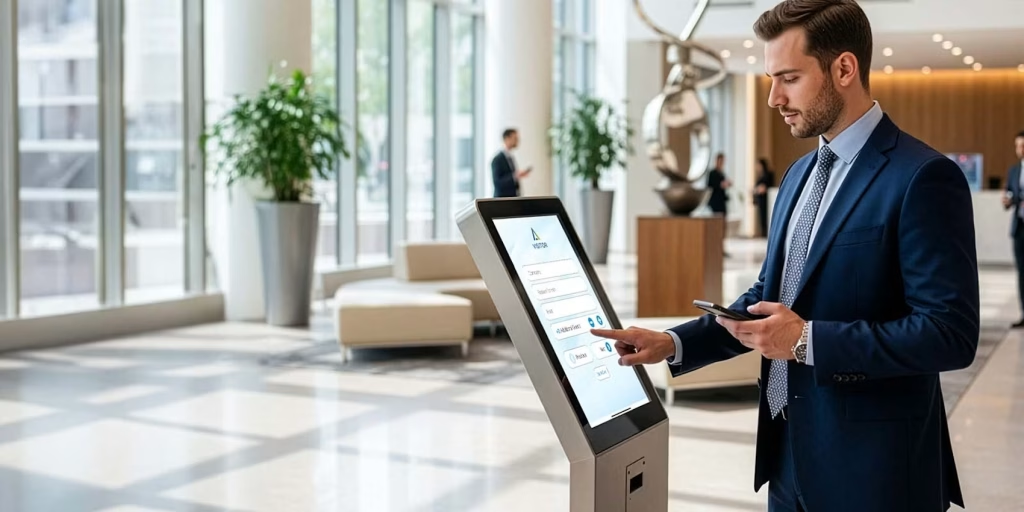
Dubai’s transformation is woven into the Dubai 2040 Urban Master Plan, with investments in smart infrastructure designed to position the emirate as an international leader in technological innovation. Businesses that align their operations with that standard send a clear signal: we belong in this city’s future, not its past. A lobby experience that is slow or manual undermines that signal before a single meeting has taken place.
Security Is The First Priority
Smart reception is not purely about experience. In a city with a significant concentration of government entities, regulated free zones, and international corporations, access control carries real weight.
IX VISPRO’s visitor management platform captures verified identity through Emirates ID and passport scanning, not just a typed name in a form. Every visit is logged with a timestamp and photo, creating a complete audit trail that satisfies both internal security requirements and UAE data protection standards under Federal Decree-Law No. 45. Watchlist screening happens automatically at check-in. If a visitor does not belong in the building, the system flags it before they get past the lobby.
For businesses operating in DIFC, ADGM, or any Dubai free zone with formal compliance obligations, that level of documented, verified access control is increasingly expected, not just good practice.
Pre-Registration: The Detail That Changes the Experience
One feature that separates a genuinely smart reception from a basic digital sign-in is pre-registration. When a host registers a visitor in advance, that visitor receives a QR code before they arrive. They walk in, scan the code, receive their badge, and their host is notified, in under 20 seconds.
For a corporate office regularly hosting senior clients, board delegations, or government representatives, that frictionless arrival is part of the service. It reflects the same logic that Digital Dubai has applied to government services, the best interaction is one that requires the least effort from the person on the receiving end.
The Standard Has Already Changed
Dubai’s Smart City vision did not create a future expectation. It created a present one. The clients and partners visiting corporate offices in 2026 are already accustomed to seamless digital experiences in every other part of their lives, airports, hotels, government services, banking. The corporate reception area is one of the last places where that expectation routinely goes unmet.
The organisations closing that gap are not just improving their lobbies. They are making a statement about how they operate and what they stand for, which, in a city as competitive and internationally visible as Dubai, is a statement worth making.
If you are ready to bring your reception area in line with the city around it, explore what IX VISPRO delivers for corporate offices across the UAE.
Frequently Asked Questions
What is a smart reception and how is it different from a regular front desk?
A smart reception uses digital technology to automate the visitor check-in process. Instead of a receptionist manually logging details, a self-service kiosk handles verification, badge printing, and host notification automatically. The result is a faster, more secure, and more professional experience for every visitor.
Is IX VISPRO suitable for small businesses?
Yes. IX VISPRO is scalable and works for single-location offices as well as large multi-site operations across the UAE.
Does VMS work without the internet?
Yes. IX VISPRO operates fully offline and syncs all data automatically once the connection is restored.
Does the system support Arabic?
Yes. IX VISPRO has native Arabic and English interfaces across both the kiosk hardware and the management software, making it fully suited for the UAE market and the wider MEA region.
Can IX VISPRO integrate with our existing access control or building management system?
Yes. IX VISPRO is built for flexible integration with third-party speed gates, elevator controls, biometric readers, ANPR systems, HR platforms, and building management systems. In most cases, existing hardware does not need to be replaced.