

Compliance audits have a way of exposing the gaps organisations did not know they had.
A company can invest heavily in cybersecurity infrastructure, endpoint protection, and access control systems, and still discover a physical-access gap during an audit: incomplete visitor logs, missing exit times, or contractor records that were not consistently maintained. Not a data breach. Not a failed penetration test. A spreadsheet with missing exit times and a few blank rows where someone forgot to log a contractor.
This is not unusual. Visitor management can become an audit concern when physical-access records are incomplete or inconsistently maintained, precisely because organisations treat it as an operational detail rather than a compliance control. In practice, it is both, and the way you manage it matters.
How ISO 27001 and SOC 2 Address Physical Access
ISO 27001 includes specific controls for physical entry and security, while SOC 2 addresses physical access through its Logical and Physical Access Controls criteria. The language differs between the two frameworks, but the underlying objective is similar: organisations need appropriate controls and evidence to demonstrate that physical access to facilities is managed consistently.
During an audit, organisations may be asked to provide recent visitor and physical-access records to demonstrate that relevant controls are operating consistently. Auditors may review whether entries are complete, whether exit times are recorded, how visitor identity is verified, and whether access to restricted areas is appropriately controlled.
For SOC 2 Type II, controls also need to operate consistently throughout the audit period. A process that works when staff remember to enforce it but breaks down on a busy afternoon or when someone is covering the desk can make it difficult to demonstrate that the control is operating consistently.
A manual process, whether that is a shared spreadsheet, a digital form, or even a well-maintained database that relies heavily on staff input, can make it more difficult to demonstrate that physical-access controls are applied consistently and supported by complete evidence.
Where Manual Systems Fall Short
The problem with staff-dependent visitor logging is not effort or intention. Most teams that manage visitor records do so carefully. The issue is consistency.
A visitor arrives when the receptionist is on a call. The entry gets logged five minutes later, with an approximate arrival time. A contractor leaves through a side exit and forgets to sign out. A delivery driver is waved through without formal registration because the process feels disproportionate for a two-minute drop-off. A pre-registered visitor is checked in informally because their host came down to meet them and bypassed the desk entirely.
None of these feel like compliance failures in the moment. Collectively, over the course of an audit period, they can produce exactly the kind of incomplete record that auditors may flag.
The control needs to be systematic, not effortful. When the system handles logging automatically at the point of entry, the check-in process and the creation of the visitor record become the same event, reducing opportunities for missing or inconsistent information.
What a Visitor Management System Provides
A properly deployed visitor management system can support several physical-access controls and evidence requirements relevant to ISO 27001 and SOC 2, not as a side effect but as a core function of how it operates.
Verified identity at entry
Physical-access controls may include appropriate visitor identification and verification procedures, depending on the organisation’s risk environment and control design. IX VISPRO reads Emirates ID and passport data directly at the kiosk, capturing information from the identity document rather than relying entirely on what a visitor types into a form. That distinction can provide useful evidence when an organisation needs to demonstrate how visitor identity was verified.
Complete and consistent audit trails
Every check-in is timestamped automatically. Every check-out is recorded. The visitor’s name, organisation, host, purpose of visit, and photo are captured at the point of entry, every time, regardless of how busy the desk is or who is covering reception. The system creates a consistent digital record of visitor activity that can be retrieved and exported for audit review in Excel or PDF format.
Badge issuance and zone control
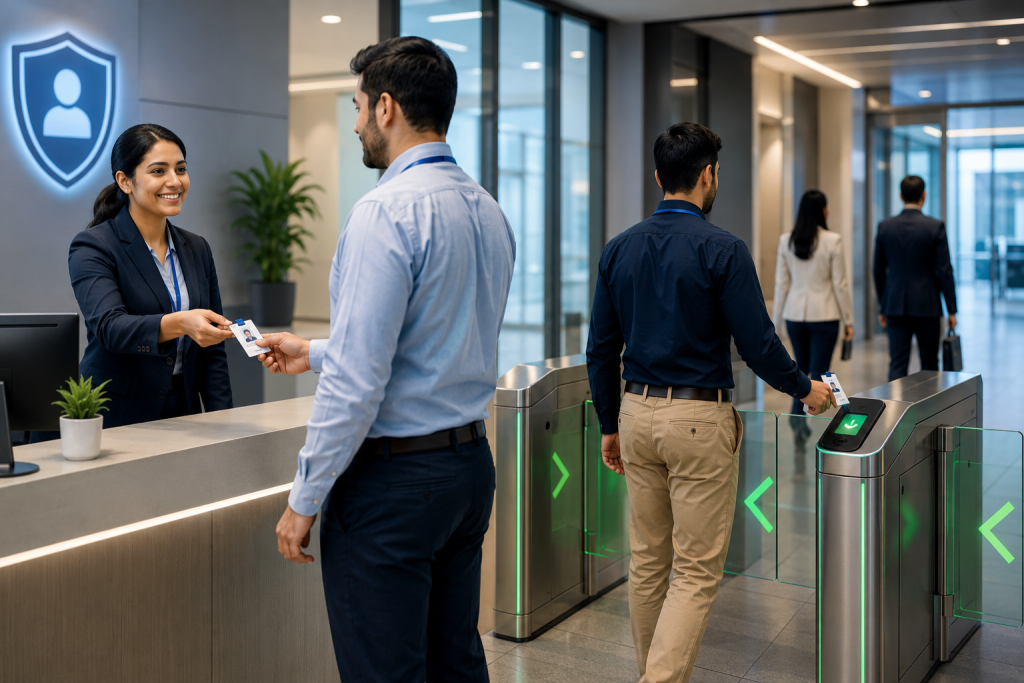
ISO 27001 includes physical-entry controls covering access to secure areas, and organisations may use visitor identification and designated-area restrictions as part of those controls. IX VISPRO prints a badge at check-in with the visitor’s name, photo, host name, and access zone. Zone-based access controls can help define and enforce the areas a visitor is authorised to access.
Host accountability built into the process
When a visitor checks in, the host receives an instant notification by SMS and email. The record of who accepted responsibility for that visitor is captured automatically. This can support visitor accountability and escort procedures by creating a record of the host responsible for the visit, without requiring staff to remember an additional manual step.
Watchlist screening before entry
Before a visitor is granted access, the system screens their identity against configured watchlists. If a flagged individual attempts to check in, security is alerted before they enter the facility. This can provide a more consistent screening process than relying entirely on manual checks.
Data protection and retention
Visitor records contain personal information and should be retained, protected, and access-controlled appropriately. IX VISPRO provides security, access-control, and retention features that can support an organisation’s data-protection obligations. Visitor information is protected through access controls designed to restrict it to authorised personnel.
What Auditors Actually Ask For
Knowing what an auditor will look for makes preparation straightforward rather than stressful. For visitor management specifically, organisations may need to provide:
- Recent visitor logs, including entry times, exit times, visitor details, and host information
- Evidence of how visitor identity is verified at the point of entry
- Confirmation of how visitors are identified while on site
- Documentation of how contractors and third-party vendors are managed
- Records of any access alerts or flagged entries during the review period
- Confirmation of how visitor data is stored, protected, and retained
A digital visitor management system can make this evidence easier to document, retrieve, and present during an audit. A manual system can require more effort to demonstrate that records are complete and that procedures have been applied consistently.
The UAE Compliance Context
For organisations in the UAE, compliance obligations extend beyond ISO 27001 and SOC 2. Entities in DIFC and ADGM operate under their own data-protection frameworks, which may apply to personal information collected through visitor-management processes. Organisations subject to applicable UAE government information-assurance requirements may also have additional physical and information-security controls to consider. Healthcare facilities are regulated by DHA, DOH, and MOHAP, each with specific access control expectations.
IX VISPRO is designed to support organisations operating in environments with layered security and compliance requirements. Emirates ID and passport scanning, zone-based access control, audit-ready reporting, and multi-site management from a single dashboard make it a practical fit for organisations navigating layered compliance obligations across the UAE and the wider MEA region.
Compliance Is Not a Once-a-Year Exercise
The audit is not the event. It is the moment that reveals whether controls have been working reliably every day in between. A visitor management system that generates a consistent record of visitor activity does not just help at audit time. It can provide ongoing evidence that physical-access procedures are being applied in practice, rather than simply documented in policy.
If your organisation is working toward ISO 27001 certification, preparing for a SOC 2 Type II review, or tightening access controls across UAE facilities, get in touch with the IX VISPRO team to see how the platform supports your specific requirements.
Read more: The Future of Front Desk Operations in the UAE: Going Digital in 2026